
Estimated reading time: 4 minutes
Table of Contents
- Same Order, Very Different Insects
- How to Tell Them Apart by Sight & Behavior
- What’s Actually Buzzing Around Your Yard
- Nesting Habits & When to Call for Help
- Get the Identification Right Before You Act
You’re grilling on a Saturday afternoon when something large and yellow streaks past your head and disappears under the eave. Or maybe it’s a fat, fuzzy thing circling your flower bed, or a slender, aggressive insect that dive-bombed you the moment you walked toward the fence. Before you grab a can of spray or call for help, it pays to know what you’re actually dealing with. A honey bee colony, a yellowjacket nest, and what most people call a “hornet” each call for a different response.
At Pest Pros Pest Solutions, we’ve built over 40 years of combined experience helping Sacramento-area homeowners and businesses handle exactly this kind of situation. Identifying the insect correctly isn’t just a matter of curiosity. It determines whether you need a beekeeper, a pest control professional, or nothing more than some patience. What follows is a practical guide to telling these stinging insects apart, with a focus on the species that actually show up in Northern California.
Same Order, Very Different Insects
Bees, wasps, and hornets all belong to the order Hymenoptera, a classification that also includes ants and sawflies. Within that grouping, hornets are technically a subset of wasps. Every hornet is a wasp, but most wasps aren’t hornets. The family Vespidae covers yellowjackets, paper wasps, and true hornets, while bees occupy a separate branch of the same evolutionary tree.
The dietary split between bees and their wasp relatives matters for identification. Bees are herbivores, evolved to collect nectar and pollen to feed their colonies. Wasps and hornets are largely predatory or omnivorous, hunting other insects for protein and supplementing with sugars from fruit, carrion, and whatever you’re eating at your picnic. That’s why yellowjackets hover around your soda can while a bumblebee ignores it entirely. One other note: only female bees, wasps, and hornets carry a stinger, since it evolved from an egg-laying organ.
How to Tell Them Apart by Sight & Behavior
Body shape is the fastest way to distinguish a bee from a wasp. Bees have dense, hairy bodies adapted for picking up pollen, and you’ll often see pollen packed onto their hind legs. Wasps and hornets have smooth, mostly hairless bodies with a pronounced narrow waist between the thorax and abdomen. In flight, yellowjackets tend to let their legs dangle visibly beneath them; bees tuck theirs in.
Stinging behavior is where the distinction really matters from a safety standpoint. Honey bees have barbed stingers that catch in skin, causing the bee to die after a single sting. Wasps and hornets have smooth stingers and can sting repeatedly. Social species, including yellowjackets and paper wasps, defend their nests aggressively when disturbed, making nest proximity the real risk variable. Solitary wasp species rarely sting because there’s no colony to protect.
What’s Actually Buzzing Around Your Yard
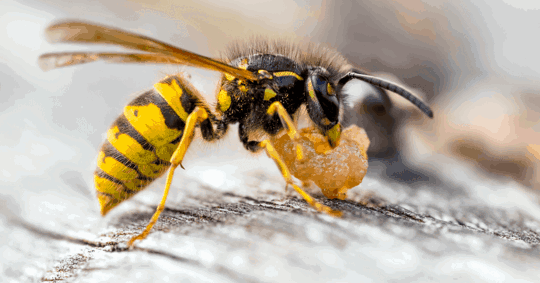
Here’s where most national identification guides leave readers without useful information. The two stinging insects responsible for the overwhelming majority of complaints in this area are the western yellowjacket (Vespula pensylvanica) and the German yellowjacket (Vespula germanica), both confirmed by the Sacramento-Yolo Mosquito and Vector Control District as the dominant yellowjacket species in our region. Both are yellow and black, medium-sized, and highly defensive of their nests. The European paper wasp (Polistes dominulus) is also common here and gets mistaken for a yellowjacket regularly because of its similar coloration, though it has a longer, more slender body and tends to be somewhat less aggressive.
About that “hornet” in your yard: true hornets belong to the genus Vespa and aren’t established in western North America. California has documented only sporadic, solitary specimen sightings. What Sacramento residents typically call a hornet is either the bald-faced hornet (which is actually a species of yellowjacket, not a true hornet) or simply a large yellowjacket. The bald-faced hornet is notably larger, black and white rather than yellow and black, and builds the large, papery, football-shaped aerial nests you might see hanging from tree branches.
One regional detail worth knowing: a 2018 peer-reviewed study published in PLOS One identified Napa and Sacramento counties as the current northernmost documented range of Africanized honey bees in California, though at low density. Africanized honey bees are nearly identical in appearance to European honey bees but defend their colonies far more vigorously and in far greater numbers. Most honey bees in the Sacramento area are still the docile European type, but any unknown established hive (particularly one in a wall void or other enclosed space) warrants professional assessment rather than a do-it-yourself approach.
Nesting Habits & When to Call for Help
Timing matters as much as species. In the Sacramento area, queen yellowjackets emerge from overwintering around March or April and begin building nests. Colony size grows through spring and summer, reaching its peak between August and October, when yellowjacket aggression is most intense and food competition is highest. Activity typically drops off by November as temperatures cool and the colony cycle ends.
Nest location tells you a great deal about what you’re dealing with:
- Underground nests are most commonly the western yellowjacket (Vespula pensylvanica), which frequently uses abandoned rodent burrows. These are easy to disturb accidentally while mowing or gardening.
- Nests in wall voids, attics, and eaves are more typical of German yellowjackets and, when flat and open-faced, paper wasps. Nests inside walls can grow significantly before they’re visible from the outside.
- Aerial paper nests hanging from branches or overhangs usually belong to paper wasps or bald-faced hornets. These are visible and easier to spot before they get large.
Any situation involving multiple stings, or signs of an allergic reaction such as widespread hives, swelling beyond the sting site, shortness of breath, or dizziness, requires immediate emergency medical care. Anaphylaxis can develop from a single sting and is potentially life-threatening regardless of which stinging insect was involved. If someone in your household has a known venom allergy, a nest anywhere on the property isn’t a wait-and-see situation.
Get the Identification Right Before You Act
A honey bee colony should be relocated by a beekeeper whenever possible, not exterminated, because managed bee populations are genuinely valuable. A yellowjacket or paper wasp nest calls for removal, ideally before the colony peaks in late summer. Attempting either without the correct identification risks making the wrong call. Disturbing a large, established yellowjacket nest without proper protection can turn a manageable problem into a medical emergency fast.
If you’re not certain what you’re looking at, or if the nest is large, inside a wall, or in a high-traffic area of your yard, don’t guess. We offer same-day service for Sacramento-area homeowners who contact us before noon, and our preventative approach is designed to address stinging insect problems before they reach the August peak. Call us at (916) 588-9345.